Entertainment
Afrobeats Makes History Again as Lagos Orchestra Performance Earns Guinness World Record
Afrobeats has achieved another global milestone after a Lagos concert organised by Dapper Live & Artists earned a Guinness World Record for the largest orchestra at an Afrobeats concert. The record-breaking performance brought 85 musicians together with a conductor, choir, dancers and singers, demonstrating how a sound born from African creativity continues to expand beyond clubs and streaming platforms into ambitious new forms of live performance.
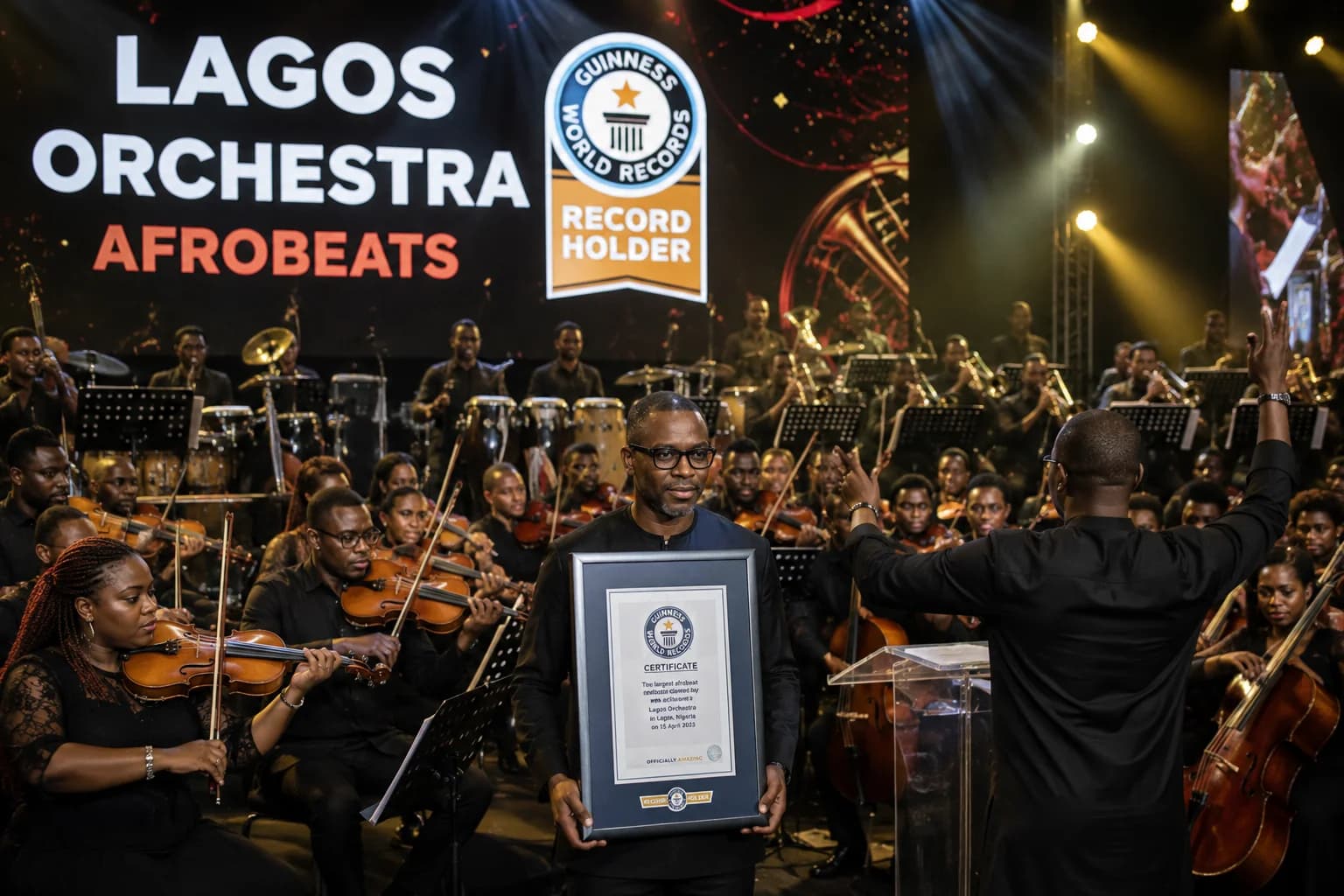
Afrobeats has made history again.
This time, the story is not about a billion streams.
It is not about a Nigerian artist selling out an arena in London, Paris or New York.
It is not about another international collaboration or a song climbing a foreign chart.
The history was made at home, in Lagos.
A concert organised by Dapper Live & Artists has earned a Guinness World Record for the largest orchestra at an Afrobeats concert, after bringing together 85 musicians for an ambitious live performance that combined the energy of contemporary Nigerian music with the scale and discipline of an orchestra.
The record attempt took place on December 16, 2025, at the Balmoral Convention Centre in Lagos and featured a conductor-led orchestra alongside a lead singer, choir and dancers.
The achievement has now returned to the headlines following renewed public celebration of the official recognition.
But the significance of the record goes far beyond the number 85.
For years, Afrobeats has been discussed primarily through streaming numbers, celebrity collaborations, viral dances and international concerts.
The Lagos performance tells a different story.
It shows that Afrobeats is not only expanding geographically.
It is expanding musically.
A genre once underestimated outside Africa is now demonstrating that its rhythms can work with orchestral arrangements, large ensembles, choirs and carefully coordinated live productions.
Afrobeats has already conquered playlists.
Now it is proving that it can command the concert hall.
85 Musicians, One Stage and a Historic Record
According to the official Guinness World Records listing, Dapper Live & Artists achieved the record with 85 musicians performing together at the Lagos event.
The performance was built around an Afrobeats composition and coordinated under the direction of a conductor.
The event also featured a choir, dancers and a lead singer, creating a performance that connected the structure of a large orchestra with the energy of contemporary Nigerian popular music.
The concert also brought together performers from different parts of Nigeria’s musical landscape.
Reports say the event featured Fuji stars Saheed Osupa and KS1 Malaika alongside contemporary Afrobeats and street-pop performers including T.I Blaze, Rybeena, Bhadboi OML and TML Vibez.
That mixture matters.
Nigeria’s music industry is often discussed as though each generation has replaced the one before it.
But the country’s musical evolution is more complicated.
Afrobeats carries influences from older Nigerian traditions while continuously absorbing new sounds from street-pop, Fuji, highlife, hip-hop, R&B and electronic music.
The record-breaking performance demonstrated what can happen when those musical worlds are treated not as competitors but as parts of a wider creative ecosystem.
From Lagos Streets to Global Culture
The rise of Afrobeats is one of Africa’s most remarkable cultural stories.
The sound developed through years of experimentation by Nigerian and African artists, producers, DJs, dancers and music executives.
For a long time, international recognition came slowly.
African artists often had to fight for visibility.
International award categories frequently grouped the continent’s diverse music into broad labels.
Major global markets consumed African music without always understanding the industries and communities behind it.
Then the balance began to change.
Streaming platforms made it easier for music to travel without waiting for traditional gatekeepers.
Social media allowed songs to move between Lagos, Accra, London, Johannesburg, New York and other cities almost instantly.
African diaspora communities helped create international audiences.
Collaborations introduced new listeners.
And gradually, Afrobeats moved from being described as an emerging sound to becoming an established part of global popular culture.
The Guinness record in Lagos represents another stage of that evolution.
Afrobeats no longer needs to prove that people will dance to it.
The next challenge is to prove the full scale of what can be built around it.
The Record Shows Afrobeats Can Be More Than a Streaming Economy
Much of the modern music conversation revolves around numbers.
How many streams?
How many monthly listeners?
How many TikTok videos?
How many chart positions?
Those numbers matter because they can demonstrate reach.
But a sustainable music industry requires more than digital consumption.
It needs venues.
It needs musicians.
It needs sound engineers.
It needs stage designers.
It needs lighting professionals.
It needs choreographers.
It needs composers and arrangers.
It needs managers, lawyers, publishers, promoters and technical crews.
A large-scale orchestral Afrobeats performance creates opportunities across a much wider creative economy than simply uploading a song to a streaming platform.
That is why this record should be viewed as more than entertainment news.
It is also a business story.
Nigeria has created one of the world’s most influential contemporary musical movements.
The country must now ask whether it is building enough of the infrastructure required to capture the economic value created by that movement.
Nigeria Must Own More of the Business Behind Its Culture
Afrobeats is Nigerian cultural power.
But cultural influence and economic ownership are not always the same thing.
As the genre becomes more valuable globally, international companies are increasingly involved in distribution, publishing, touring, promotion and rights management.
There is nothing unusual about international investment in a growing industry.
The danger comes when the creators of culture generate global value while the strongest commercial structures surrounding that culture are built elsewhere.
Nigeria needs more locally owned music companies with the capacity to compete internationally.
It needs stronger publishing systems.
It needs better copyright enforcement.
It needs modern performance venues.
It needs reliable ticketing infrastructure.
It needs professional music education and technical training.
It needs investment in touring infrastructure.
And artists need better understanding of contracts, royalties and ownership.
A Guinness World Record is a reason to celebrate.
But the bigger goal should be building an industry strong enough to ensure that Nigerian creativity creates lasting Nigerian wealth.
Lagos Is More Than the Background to the Afrobeats Story
The record was achieved in Lagos, and that matters.
For decades, the city has been one of the major engines of African popular culture.
Artists arrive in Lagos with ambition.
Producers build sounds in studios across the city.
Songs move from neighbourhoods to radio stations and clubs.
Dance movements begin locally and spread internationally.
Record labels, entertainment companies and media platforms compete for attention.
The city is chaotic, expensive and difficult.
Yet it continues to produce culture consumed far beyond Nigeria.
The Guinness World Record is therefore another reminder that Lagos is not simply where Afrobeats artists happen to live.
The city is part of the machinery that creates the culture.
But Lagos also needs better infrastructure if it wants to remain one of the world’s important music capitals.
A globally influential music city needs more world-class venues of different sizes.
It needs safer and more reliable transportation for concert audiences.
It needs better event infrastructure.
It needs a strong night-time economy supported by security and sensible regulation.
Music can create jobs and tourism.
But only if cities treat culture as an industry rather than an occasional celebration.
The Fusion of Fuji and Afrobeats Carries a Powerful Message
The involvement of major Fuji performers alongside younger Afrobeats acts is one of the most interesting elements of the concert.
Nigeria’s music did not begin with the streaming era.
Before international audiences became familiar with the word Afrobeats, generations of Nigerian musicians had already built rich traditions.
Fuji developed its own stars and audiences.
Highlife travelled across regions.
Juju music produced major performers.
Afrobeat carried political messages and complex instrumentation.
Contemporary Afrobeats emerged from a country with deep musical foundations.
Bringing Fuji and modern Afrobeats performers into an orchestral environment therefore creates a conversation between generations.
It reminds younger audiences that music evolves.
The future does not have to destroy the past.
It can reinterpret it.
That may become one of the most exciting directions for Nigerian music in the years ahead.
Afrobeats Has Reached the World—Now the Industry Must Grow Up
Global popularity creates opportunity.
It also creates pressure.
As Afrobeats becomes more commercially valuable, the industry surrounding it must become more professional.
Artists need stronger contracts.
Producers need fair compensation.
Songwriters need accurate royalty collection.
Managers need professional standards.
Concert promoters need better safety systems.
Consumers need reliable ticketing.
Creative workers need careers that can survive beyond one viral song.
Nigeria cannot build a sustainable music economy around celebrity alone.
For every famous singer on stage, there are hundreds of professionals whose work makes the performance possible.
The 85 musicians involved in the record-breaking orchestra are a powerful symbol of that wider ecosystem.
The future of Afrobeats should create opportunities not only for superstars but for instrumentalists, composers, arrangers, backing vocalists, dancers and technical professionals.
A mature industry creates careers.
Not just celebrities.
Nigeria Should Build Music Education Around Its Own Success
There is another lesson from the record.
Nigeria needs to think more seriously about music education.
Many young Nigerians want careers in entertainment, but the path into professional music is often informal and uncertain.
There should be stronger opportunities to study music production, sound engineering, composition, stage management, lighting design and entertainment business.
An industry cannot grow indefinitely without skilled professionals.
The orchestra record demonstrates that modern Nigerian music and formal musical structures can work together.
That should inspire greater collaboration between universities, conservatories, private academies and the entertainment industry.
Young musicians should be able to study orchestral instruments while understanding contemporary African music.
Producers should be able to learn both technical sound engineering and the business of intellectual property.
The industry needs talent.
But it also needs knowledge.
A Guinness Record Is a Moment—Building an Industry Is the Mission
Records are powerful because they create memorable moments.
But moments pass.
The larger question is what comes after.
Will the Lagos performance inspire more ambitious live productions?
Will other African genres experiment with orchestral performance?
Will more investors support large-scale music projects?
Will Nigerian cities build better venues?
Will young instrumentalists see new career opportunities?
Will Nigerian companies own more of the infrastructure around the music they help create?
Those are the questions that will determine the true legacy of the record.
Afrobeats has already shown that it can travel.
It has shown that it can dominate clubs.
It has shown that it can fill arenas.
It has shown that it can generate billions of streams.
Now, in Lagos, 85 musicians have shown that it can also become something grander: a large, coordinated live musical experience built around African rhythm and contemporary Nigerian creativity.
Afrobeats Is No Longer Asking for Permission
Perhaps the most powerful part of the story is what it represents psychologically.
For years, African music industries often looked outward for validation.
Success meant being recognised somewhere else.
A foreign award.
A foreign collaboration.
A foreign chart.
A foreign arena.
Those achievements still matter.
But the Lagos record offers another model.
Create something ambitious at home.
Build it around African music.
Use local artists and musicians.
Make the production world-class.
Then allow the world to recognise what has been created.
That is a more confident form of cultural power.
Afrobeats does not need to become less African to become more global.
Its greatest strength has always been its ability to take local experiences, languages, rhythms and energy and make them travel.
The orchestra in Lagos did not abandon Afrobeats.
It expanded it.
And that may be the most important meaning of this Guinness World Record.
The story is not simply that 85 musicians performed together.
The story is that a musical movement born from African creativity continues to discover new ways to express itself.
From the streets to streaming platforms.
From nightclubs to stadiums.
From speakers to symphonies.
Afrobeats is still evolving.
And once again, Lagos is at the centre of the story.
PUBLISHER NOTE
About Talk Ya True
Talk Ya True publishes independent reporting and analysis with clear attribution, source transparency and corrections when needed.
Related Articles
Entertainment
Edo Government Denies Banning Davido as Governor’s Aide Warns Singer to Stay Away
Entertainment
Police Say Davido Was Target of Osun Convoy Attack That Left Man Dead

Entertainment
Mohbad Case Takes Fresh Turn as VDM Revives DNA Questions, Releases New Audio and Raises Fresh Questions Over Royalties

Entertainment
Shallipopi Revives Dapper Dispute, Demands Answers Over Alleged Unpaid Royalties
Stay Informed
Get the latest stories from Nigeria.
Free news updates. Unsubscribe anytime.
By subscribing, you agree to receive free news updates from Talk Ya True. You can unsubscribe at any time.