Opinion
Every Time Gunmen Attack a School, Nigeria Loses More Than the Children They Kidnap
Nigeria’s repeated school kidnappings are creating a generation of children who may begin to see education itself as dangerous. Rescuing abducted students matters, but a country cannot keep celebrating rescues while failing to make schools safe.
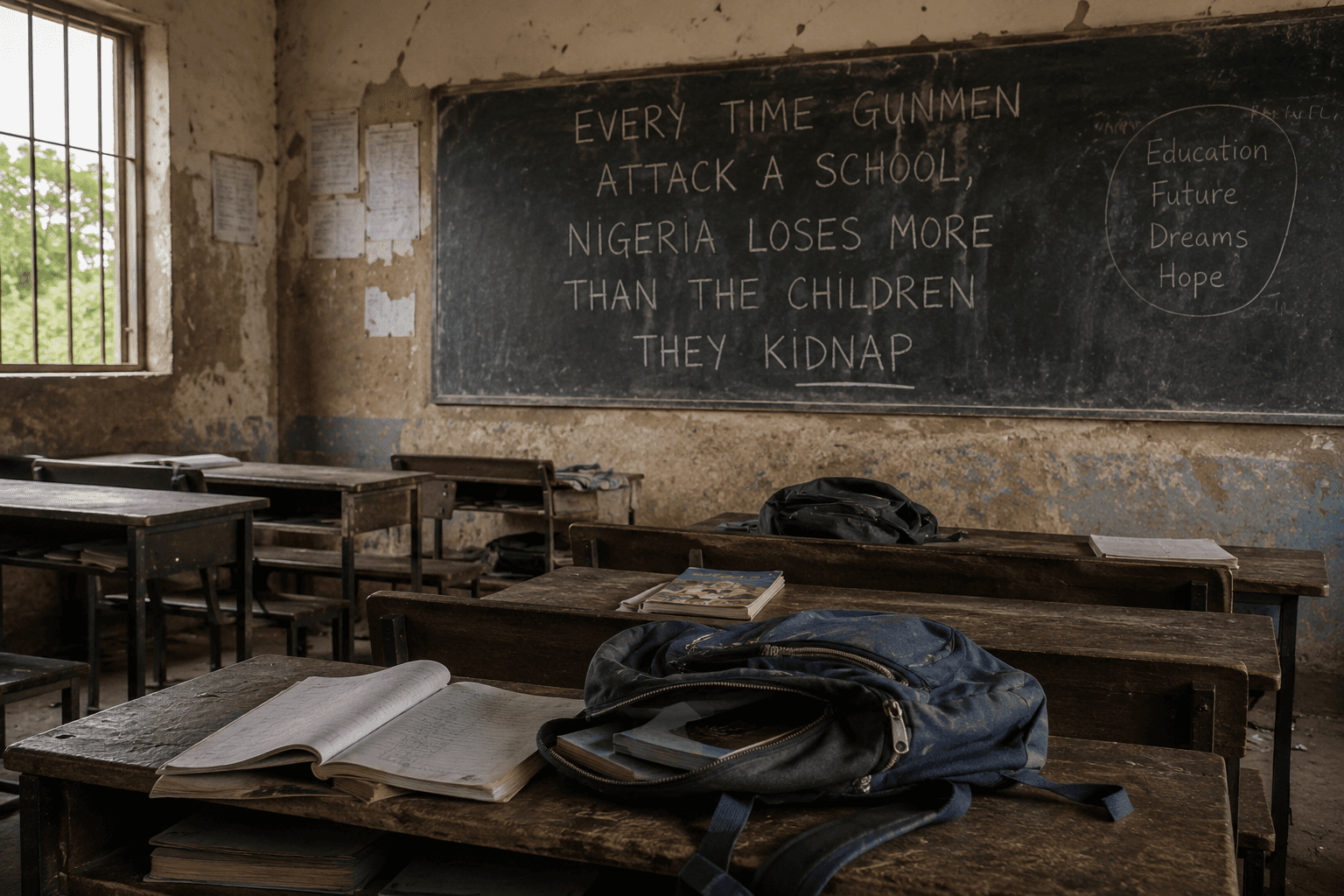
There is something deeply disturbing about the way Nigeria has become accustomed to the kidnapping of schoolchildren.
The pattern is now painfully familiar.
Gunmen enter a school.
Children are taken.
Parents cry for help.
The country becomes angry.
Government officials promise action.
Security forces begin a rescue operation.
Some children return.
Cameras arrive.
Speeches are made.
Then Nigeria waits for the next school to be attacked.
This cannot continue to be treated as normal.
Every time armed men enter a Nigerian school and carry children away, the country loses more than the students who are kidnapped.
It loses the confidence of parents. It weakens children's belief in education. And it sends a dangerous message that even the classroom is no longer protected.
Recent reporting shows that the problem is far from over. At least 36 children and a staff member were reported missing following a school kidnapping in Borno State, the third mass school abduction reported since May 2026.
Nigeria has been here too many times before.
A Child Should Not Have to Choose Between Education and Safety
For many families in Nigeria, sending a child to school already requires sacrifice.
Parents pay for uniforms.
They find money for books.
They pay transport costs.
In some communities, children walk long distances to reach classrooms.
For poorer families, every day a child spends in school can also mean one less person helping with farming, trading or household work.
Parents make these sacrifices because they believe education can give their children a better future.
What happens when the school itself becomes a place of fear?
A mother should not have to wonder whether sending her daughter to school means she may never see her again.
A father should not have to listen for rumours of gunmen while his child sits for an examination.
And a child should not associate the classroom with the possibility of being taken into the forest.
When insecurity creates that kind of fear, the damage continues even after kidnapped children return home.
Some parents may decide not to send their children back.
Some students may never return to education.
Others may attend school carrying trauma that affects them for years.
The kidnapping ends when the child returns home. The consequences do not.
Nigeria Must Stop Measuring Success Only by Rescue
Whenever kidnapped students are released or rescued, there is understandable relief.
Families are reunited.
Communities celebrate.
The country feels that something has been achieved.
And something has been achieved. Bringing a child home safely matters enormously.
But Nigeria must ask a more difficult question:
Why was the child allowed to be kidnapped in the first place?
A security system cannot be judged only by its ability to respond after dozens of children have already been carried away.
Prevention matters.
How did armed men reach the school?
How long did the attack last?
Were there previous warnings?
How quickly did security forces respond?
Were vulnerabilities identified before the attack?
What changed after the previous kidnapping?
These questions should be asked every time, because celebrating rescue without fixing the weakness that allowed the kidnapping can turn national relief into a cycle.
The country should not become better at managing kidnappings.
It should become better at preventing them.
Chibok Should Have Changed Everything
In 2014, the kidnapping of 276 girls from Chibok shocked Nigeria and the world.
The words Bring Back Our Girls became an international campaign.
Governments made promises.
The world paid attention.
Yet more than a decade later, Nigeria is still discussing mass school kidnappings. At least 89 of the Chibok girls remain unaccounted for, according to figures cited in recent reporting.
That fact should trouble the country deeply.
Chibok should have been the event that permanently transformed school security in vulnerable areas.
Instead, Nigeria has seen repeated abductions in Zamfara, Katsina, Kaduna, Niger, Kebbi, Borno and elsewhere over the years. Recent incidents in 2026 show that schools remain targets.
The country cannot continue to react to each attack as though it is an unexpected event.
When something happens repeatedly, it is no longer an isolated tragedy.
It is a system failure.
The Criminal Business Model Must Be Broken
Kidnapping in Nigeria has become more than random violence.
In many cases, it operates like an industry.
Human beings are taken because criminals believe someone will pay for their release.
Schools can become attractive targets because the kidnapping of many children creates enormous emotional and political pressure.
The families are desperate.
The community is desperate.
The government faces public anger.
The criminals understand this.
Nigeria therefore has to confront not only the gunmen carrying out attacks but the wider systems that allow kidnapping networks to survive.
Who supplies them?
Who provides information?
Who negotiates?
How does ransom money move?
How do armed groups repeatedly travel through communities with kidnapped people without being detected?
Who benefits financially from the kidnapping economy?
Security operations are essential, but intelligence and financial investigation are equally important.
If the kidnapping economy remains profitable, another armed group will eventually replace the one that is defeated.
Poor Children Will Suffer the Most
The children most affected by school insecurity are unlikely to be those with access to heavily protected private schools.
They are more likely to be children in communities already struggling with poverty, conflict and limited access to education.
This creates another inequality.
The child of a wealthy family may study behind walls, guards and security systems.
The child of a poor rural family may attend a school with little protection in an area where armed groups operate.
Both children are Nigerian.
Both deserve safety.
If insecurity continues forcing schools to close or parents to withdraw children from education, the communities already facing the greatest disadvantages will fall even further behind.
Girls may be particularly affected.
In communities where families are already uncertain about educating girls, fear of kidnapping can become another reason to keep daughters at home.
Nigeria cannot claim to be investing in its future while insecurity is pushing children away from classrooms.
School Security Must Be More Than a Policy Document
Nigeria does not lack speeches about security.
The problem is whether protection can be felt where it matters.
A school security strategy should begin with an honest assessment of which schools are most vulnerable.
Not every school faces the same level of risk.
Schools in high-risk areas need functioning communication systems, clear emergency procedures, reliable relationships with nearby security units and realistic response plans.
Communities also matter.
Residents often understand local movements and unusual activity better than officials operating from distant offices.
Trust between communities and security agencies can help information move before an attack rather than after one.
Infrastructure matters too.
A security vehicle cannot respond quickly if roads are impassable.
Communication systems cannot help if they do not work.
A policy announced in Abuja means little if a headteacher in a vulnerable village has no practical way to call for immediate help.
The standard should be simple:
Can this school detect danger, raise an alarm and receive help quickly?
If the answer is no, then the school is not secure, regardless of how many policies exist on paper.
The Psychological Damage Deserves Attention Too
There is another part of the crisis Nigeria does not discuss enough.
What happens to children after they return?
A rescued child may have experienced violence, hunger, fear, separation and uncertainty.
Returning home is not the end of recovery.
Children who survive abduction may need long-term psychological support, medical care and help returning to education.
Families may also need support.
Parents can experience guilt, fear and financial devastation after an abduction.
Communities themselves can be traumatised.
If Nigeria focuses only on physically bringing children home but ignores what happens afterwards, many survivors will be left to carry invisible injuries alone.
A Country That Cannot Protect Education Is Endangering Its Future
Nigeria often speaks about its young population as an advantage.
We are told that the youth are the future.
But a young population becomes an advantage only when children are educated, healthy and given opportunities.
A country cannot build a modern economy while children are afraid of classrooms.
It cannot reduce poverty while insecurity pushes vulnerable families away from education.
It cannot compete in technology, science, medicine and industry if armed groups are allowed to decide which communities can safely educate their children.
School kidnapping is therefore not only a security issue.
It is an education issue.
An economic issue.
A development issue.
And a question about what kind of country Nigeria intends to become.
The rescue of every kidnapped child should be celebrated.
But Nigeria must aim higher than rescue.
The real victory will be the day parents can send their children to school without wondering whether armed men will arrive before the children return home.
Until then, every school kidnapping is not just an attack on a group of children.
It is an attack on Nigeria's future.
This article represents the editorial opinion of Talk Ya True.
PUBLISHER NOTE
About Talk Ya True
Talk Ya True publishes independent reporting and analysis with clear attribution, source transparency and corrections when needed.
Related Articles

Opinion
Opinion: Nigeria Must Stop Waiting for Doctors to Threaten Strikes Before Taking Action
Opinion
Opinion: The Real Tragedy in Asaba Isn't Just the Fuel Scooping - It's the Desperation Behind It
Opinion
Opinion: Why Many Nigerians Are Questioning the Official Story Behind the Oyo Schoolchildren's Rescue

Opinion
Nigeria Doesn't Have a Revenue Problem - It Has an Accountability Problem
Stay Informed
Get the latest stories from Nigeria.
Free news updates. Unsubscribe anytime.
By subscribing, you agree to receive free news updates from Talk Ya True. You can unsubscribe at any time.