Sports
France End Africa’s World Cup Dream Again as Mbappé and Dembélé Knock Morocco Out
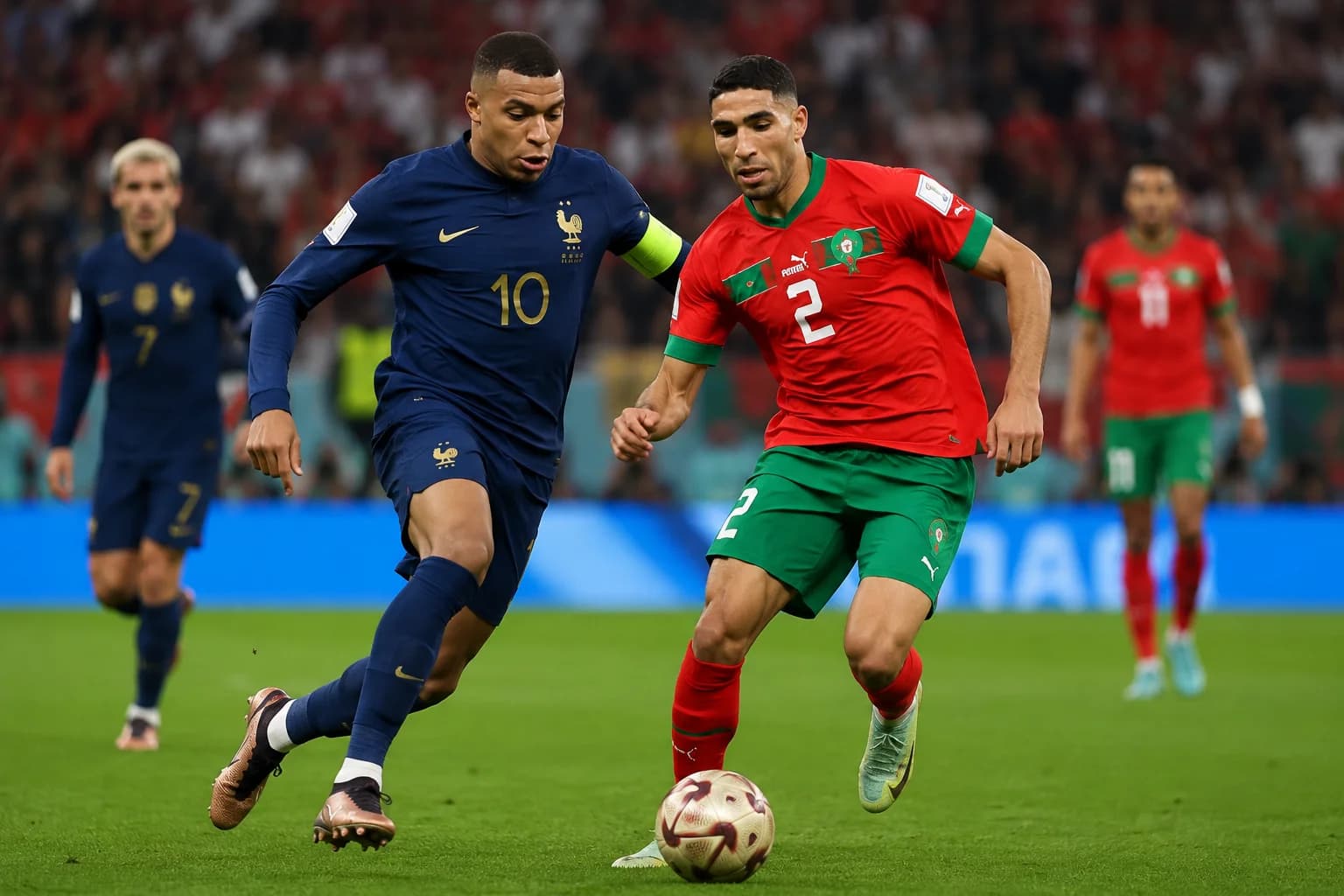
Morocco’s dream of carrying Africa into the 2026 World Cup semi-finals has ended after France defeated the Atlas Lions 2–0 in their quarter-final clash in Boston. Kylian Mbappé recovered from a missed penalty to break the deadlock before Ousmane Dembélé doubled France’s advantage, ending a Moroccan campaign that once again showed African football can compete with the world’s strongest nations.
Africa believed.
Morocco dreamed.
But once again, France stood in the way.
Four years after ending Morocco’s historic run at the 2022 World Cup, France have broken Moroccan hearts again, defeating the Atlas Lions 2–0 in Boston to advance to the semi-finals of the 2026 FIFA World Cup.
The scoreline was painfully familiar.
France 2.
Morocco 0.
The same result that ended Morocco’s extraordinary World Cup journey in Qatar four years ago has now ended another remarkable campaign.
But this was a different Morocco.
They were no longer the surprise package nobody expected to reach the final stages of a World Cup.
They arrived at this quarter-final as a respected football nation, an African champion and a team that had already proved it could compete with some of the strongest sides in world football.
Still, when the decisive moments arrived, France had what Morocco could not find.
Goals.
Kylian Mbappé recovered from a missed first-half penalty to put France ahead in the second half, before Ousmane Dembélé struck soon afterwards to give Les Bleus control of the match. France then managed the remaining minutes professionally to secure their place in the semi-finals.
For Morocco, the journey is over.
For Africa, the wait continues.
And for France, the dream of another World Cup title is becoming increasingly serious.
Mbappé Missed From the Spot—but France’s Captain Would Not Stay Quiet
For a moment, Morocco believed the night might belong to them.
France were awarded a first-half penalty, giving Mbappé the opportunity to put his country ahead.
The French captain stepped forward.
Yassine Bounou stood between him and the goal.
And Morocco survived.
Mbappé failed to convert the penalty, giving the Atlas Lions a huge psychological lift and keeping the match goalless heading into the second half.
For Moroccan supporters, it felt like one of those moments that can change a World Cup match.
A superstar misses.
An underdog survives.
Confidence grows.
History begins to feel possible.
But world-class players do not always disappear after failure.
Sometimes they return.
In the 60th minute, Mbappé received his second opportunity to define the night.
This time, there was no mistake.
The French captain curled a superb finish beyond Morocco’s defence and into the net, breaking the resistance that had kept France frustrated for much of the match.
It was Mbappé’s eighth goal of the tournament, according to Reuters, further strengthening his remarkable World Cup campaign.
The penalty miss had been forgotten.
France were ahead.
And Morocco suddenly had to chase the game.
Dembélé Delivered the Second Blow
Morocco barely had time to recover.
Six minutes after Mbappé’s opener, Ousmane Dembélé struck.
The second goal transformed the match.
At 1–0, Morocco still had hope.
At 2–0, they needed something extraordinary.
It never came.
Dembélé’s finish gave France the breathing space they needed and left Morocco facing the most difficult situation of their tournament.
France could manage the game.
Morocco had to take risks.
Spaces began to appear.
The clock became an enemy.
Every missed opportunity became heavier.
Every French clearance brought the Atlas Lions closer to elimination.
Morocco tried to create a late response, but France maintained their composure and closed the game out.
When the final whistle arrived, the scoreboard told the story.
France were through.
Morocco were out.
The Painful Repeat of 2022
For Moroccan supporters, the result carries an additional layer of pain.
They have seen this story before.
At the 2022 World Cup in Qatar, Morocco made history by becoming the first African nation to reach a World Cup semi-final.
They defeated Belgium.
Spain.
Portugal.
They became the pride of a continent.
Then came France.
Les Bleus won that semi-final 2–0 and ended Morocco’s dream of becoming the first African country to reach a World Cup final.
Four years later, the teams met again.
Different country.
Different stage of the competition.
Different Moroccan squad.
Same result.
France 2–0 Morocco.
Football can be cruel in the way history repeats itself.
For Morocco, France are becoming the opponent standing between an excellent generation and even greater World Cup history.
Morocco Were No Longer a Surprise
There is one major difference between Morocco’s 2022 campaign and what happened in 2026.
In Qatar, many people treated Morocco’s run as a miracle.
A beautiful accident.
A tournament in which everything came together.
That argument is becoming increasingly difficult to maintain.
Morocco arrived at the 2026 World Cup with expectations.
They drew with Brazil during their campaign and produced comfortable victories over Haiti and Scotland before navigating the knockout rounds. In the round of 16, they defeated Canada 3–0 to set up the quarter-final against France.
That is not luck.
That is evidence of a serious football nation.
Morocco may have lost to France, but African football should not misunderstand the meaning of this defeat.
The lesson is not that Africa cannot compete.
The lesson is that competing is no longer enough.
The next challenge is finishing the journey.
Africa’s Last Hope Is Gone
Morocco entered the quarter-final carrying something heavier than its own national ambition.
They were the last African team remaining in the tournament.
The continent had watched other representatives fall.
South Africa.
Ivory Coast.
Senegal.
Algeria.
Egypt.
Cape Verde.
Ghana.
DR Congo.
One after another, Africa’s teams left the competition.
Morocco remained.
For millions of African supporters, the Atlas Lions became the continent’s final hope.
That does not mean every African was supporting Morocco.
Football does not work that way.
National rivalries exist.
Regional tensions exist.
Fans choose teams for different reasons.
But there was no escaping the historical significance of Morocco’s journey.
An African nation was again deep in the World Cup.
Another opportunity existed to break a barrier that has stood since the competition began.
Now that opportunity is gone.
Africa will have to wait another four years.
Morocco’s Missing Cutting Edge Made the Difference
Morocco did many things well during the tournament.
They defended with courage.
They competed physically.
They showed tactical organisation.
They demonstrated that they could play with the ball rather than simply defend and counterattack.
But against France, one problem became impossible to ignore.
Morocco did not create enough danger when the match demanded it.
By the closing stages, Morocco had only just begun to seriously test France’s goal, while Les Bleus had already taken control through Mbappé and Dembélé.
This is the next step for African football.
Defensive organisation can carry a team far.
Courage can carry a team far.
Team spirit can carry a team far.
But at the highest level, goals decide history.
World Cup winners have players who can turn half-chances into goals.
France have Mbappé.
They have Dembélé.
They have Michael Olise and other attacking options capable of changing matches.
Morocco have excellent players.
But when the decisive moment arrived, France possessed more individual firepower.
That difference mattered.
The Absence of Ismael Saibari Hurt Morocco
Morocco also entered the match without one of their important attacking players.
Ismael Saibari had been ruled out of the quarter-final with a hamstring injury after playing an important role earlier in the tournament.
At this level, losing an influential attacking player before facing France is a serious blow.
It cannot be used as an excuse for the defeat.
Every World Cup team deals with injuries.
France themselves have had to manage fitness and selection challenges.
But Morocco’s lack of attacking threat makes Saibari’s absence particularly painful in retrospect.
In a match decided by moments of attacking quality, Morocco were missing one of the players capable of providing it.
Mbappé Is Building Another Extraordinary World Cup Story
There will be disappointment across Morocco and among many African supporters.
But France’s performance also deserves recognition.
Kylian Mbappé is continuing to build one of the great World Cup careers.
He missed a penalty.
He could have allowed frustration to affect his performance.
Instead, he scored.
That mentality separates elite players.
Mbappé has already experienced extraordinary World Cup moments in his career.
He won the tournament as a teenager in 2018.
He scored a hat-trick in the 2022 final, although France ultimately lost to Argentina on penalties.
Now he is leading another French campaign deep into the tournament.
Reuters reported that his goal against Morocco was his eighth of this 2026 World Cup.
France have many excellent players.
But this team increasingly feels like Mbappé’s team.
He is the captain.
The superstar.
The goalscorer.
The player opponents fear most.
And once again, he has delivered when France needed him.
Dembélé Proved France Are More Than One Superstar
The danger for France’s opponents is that stopping Mbappé is not enough.
Even when Morocco survived his penalty, they still had Dembélé to worry about.
The second goal demonstrated France’s attacking depth.
A World Cup-winning team cannot depend on one player alone.
There will be matches when the superstar is marked tightly.
Matches when he misses chances.
Matches when he is injured.
Matches when another player must decide the result.
Dembélé’s goal against Morocco is another reminder that France possess multiple match-winners.
That is what makes them so dangerous.
Morocco Should Leave With Their Heads High—but Not Satisfied
There is a tendency after an African team loses at a World Cup to immediately say the players should be proud.
That is true.
Morocco should be proud.
But perhaps African football also needs to become comfortable with disappointment.
Morocco are now too good to be satisfied simply because they reached a quarter-final.
They wanted to win.
They believed they could win.
They should be disappointed.
That disappointment is evidence of progress.
A football nation becomes stronger when reaching the knockout rounds is no longer considered enough.
Brazil do not celebrate quarter-final defeats.
France do not celebrate quarter-final defeats.
Argentina do not celebrate quarter-final defeats.
If Morocco genuinely wants to become part of football’s global elite, then losing to France should hurt.
Respectfully.
Realistically.
But deeply.
The goal should be to return stronger.
Morocco Have Shown Africa a Possible Path
Despite the defeat, Morocco’s rise offers lessons for the rest of Africa.
World Cup success does not begin when the tournament starts.
It begins years earlier.
With academies.
Youth development.
Coaching.
Facilities.
Scouting.
Diaspora engagement.
Sports science.
Federation planning.
Competitive domestic football.
International exposure.
Morocco have invested heavily in football infrastructure and have built systems capable of identifying and developing talent.
The country has also successfully connected with its diaspora, persuading talented players developed in European systems to represent Morocco.
That strategy has created a deeper talent pool.
It is not a perfect model.
No country’s system is perfect.
But it is a serious model.
African countries that want World Cup success must stop believing that talent alone is enough.
Africa has always had talent.
The problem has often been what happens around that talent.
African Football Must Stop Celebrating Potential Forever
Every World Cup brings familiar conversations.
Africa has talent.
Africa has physical strength.
Africa has passion.
Africa is improving.
All of those things may be true.
But how many decades can a continent survive on potential?
At some point, potential must become trophies.
Morocco have come closer than any African nation to changing the story.
Their 2022 semi-final appearance broke a historic barrier.
Their strong 2026 campaign showed that the first run was not simply a one-tournament miracle.
The next African breakthrough must go further.
A final.
Then a title.
That is the challenge.
France Are Becoming the Team Nobody Wants to Face
The rest of the tournament must now take France extremely seriously.
They have reached another World Cup semi-final.
They have experience.
They have depth.
They have one of the world’s most dangerous players in Mbappé.
They have attacking quality around him.
And they know how to survive difficult knockout matches.
France will face the winner of the Spain-Belgium quarter-final in the semi-finals.
Neither opponent will be comfortable with what they saw against Morocco.
France were not perfect.
Mbappé missed a penalty.
Morocco frustrated them for long periods.
But France remained patient.
Then their quality decided the game.
That is what champions often do.
They do not need to dominate every minute.
They need to dominate the decisive moments.
For Achraf Hakimi and Morocco, the Dream Ends in Pain
The defeat will be especially painful for Morocco’s senior players.
Achraf Hakimi and his teammates have carried enormous expectations.
They have helped change the global perception of Moroccan football.
They have made young players across the country believe that Morocco belongs at the highest level.
They have also become symbols far beyond Morocco.
Across Africa.
Across the Arab world.
Across diaspora communities in Europe.
That is a heavy responsibility.
But it is also a remarkable legacy.
Morocco did not win the World Cup.
They did not reach the semi-finals this time.
But they have helped change the expectations surrounding African football.
The next generation will not grow up believing that reaching the last 16 is the greatest possible achievement.
They have seen an African team reach a semi-final.
They have seen Morocco return four years later and reach another deep knockout stage.
The ceiling has moved.
Now someone must break through it.
France Won the Match, but Morocco Have Changed the Conversation
Football results are simple.
France won.
Morocco lost.
France advance.
Morocco go home.
But football stories are more complicated.
Morocco’s 2026 campaign ends in disappointment, but the Atlas Lions leave another World Cup having strengthened their position among international football’s most respected teams.
Nobody will underestimate Morocco at the next major tournament.
Nobody can honestly describe their success as a fluke anymore.
Nobody can say African teams are incapable of consistently competing with major football nations.
But Morocco will know that respect is not the final objective.
They want trophies.
That is the next challenge.
Africa Must Learn From This Defeat
The worst thing African football can do now is simply post messages saying, “We are proud of you,” and then return to business as usual.
Pride is deserved.
But analysis is necessary.
Why did Morocco struggle to create enough chances?
How can African teams develop more elite finishers?
How can federations improve preparation?
How can domestic leagues become stronger?
How can African countries keep talented administrators and coaches?
How can youth systems improve?
How can football federations become more professional?
How can countries build long-term plans that survive changes in leadership?
These are the questions that matter.
World Cups are won years before the final.
They are won in academies.
In boardrooms.
In coaching programmes.
In scouting networks.
In decisions about infrastructure.
In the development of 12-year-olds nobody knows yet.
Morocco understand this better than many.
Other African countries should pay attention.
The Same Score, but Not the Same Morocco
France beat Morocco 2–0 in 2022.
France have beaten Morocco 2–0 again in 2026.
The numbers are identical.
But Morocco are not standing in the same place.
In 2022, they shocked the world.
In 2026, the world expected them to compete.
That difference matters.
Expectation is the price of progress.
Morocco are no longer simply a beautiful African story.
They are becoming a football power that will be judged by results.
That is a compliment.
And a challenge.
Africa’s Dream Ends, but the Standard Has Changed
The final whistle in Boston ended Morocco’s World Cup.
It also ended Africa’s representation in the tournament.
There will be no African team in the semi-finals.
There will be no African World Cup champion in 2026.
The wait continues.
But African football is not leaving this tournament without lessons.
Morocco showed that consistency is possible.
Other African teams produced moments of quality.
The expanded tournament gave more countries opportunities to compete.
Now the continent must ask what it wants from future World Cups.
Participation?
Respect?
A heroic quarter-final?
Or the trophy?
If the answer is the trophy, then the work must begin long before 2030.
France are moving forward.
Morocco are going home.
Mbappé continues his chase for another World Cup.
Dembélé has delivered another important goal.
And Africa is left with the familiar mixture of pride and frustration.
Morocco carried the dream.
France ended it.
Again.
But this time, the message should be different.
Africa should not only ask when one of its teams will finally win the World Cup.
It should ask what must be built, changed and demanded to make that victory inevitable.
Because Morocco have already shown that the distance between Africa and football’s traditional powers is getting smaller.
The next step is the hardest one.
Closing it completely.
PUBLISHER NOTE
About Talk Ya True
Talk Ya True publishes independent reporting and analysis with clear attribution, source transparency and corrections when needed.
Related Articles

Sports
Nigeria Makes Olympic History as Mbah and Bawa Secure Beach Volleyball Ticket
Sports
Nigeria Finishes Fourth at Commonwealth Fencing Championships With 24 Medals

Sports
Cristiano Ronaldo Finally Marries Georgina Rodríguez After Nearly a Decade Together
Sports
Flying Eagles Chase Revenge Against Burkina Faso in WAFU B Final With AFCON Ticket at Stake
Stay Informed
Get the latest stories from Nigeria.
Free news updates. Unsubscribe anytime.
By subscribing, you agree to receive free news updates from Talk Ya True. You can unsubscribe at any time.