Nigeria
Defence Minister Explains Nigeria’s Kidnap Rescue Challenge, Says Sambisa Is ‘As Big as Belgium’
Defence Minister Christopher Musa has explained why rescuing kidnapped Nigerians can be difficult, pointing to the enormous and difficult terrain where terrorist groups operate. Musa compared the area known as Sambisa to Belgium, while security experts and fact-checkers note that the comparison depends on the geographical boundaries being used.
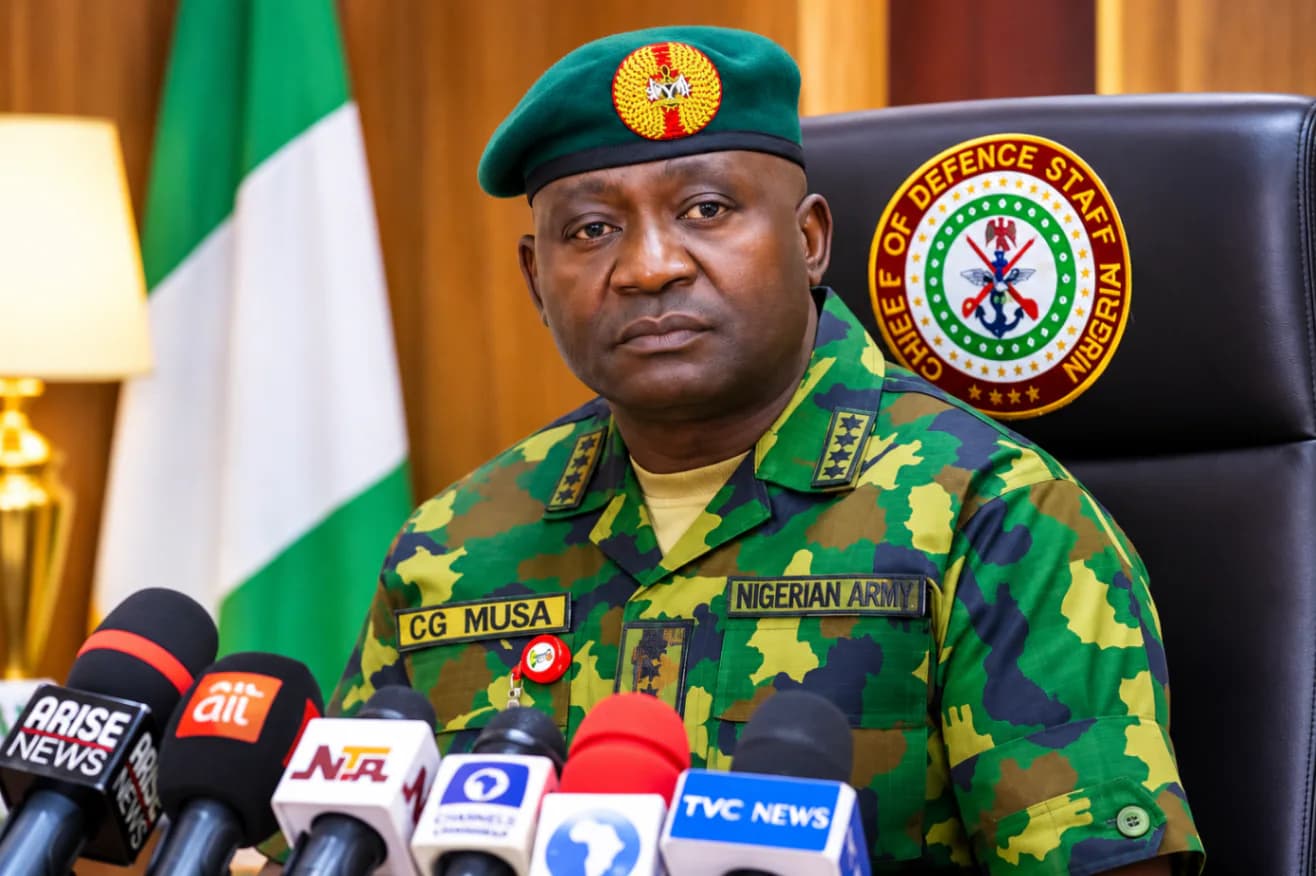
Nigeria’s Defence Minister, General Christopher Musa, has defended the government’s efforts to combat terrorism and kidnapping, saying the vast terrain in which armed groups operate remains one of the biggest challenges facing security forces.
Musa made the comments during an interview on Channels Television’s Politics Today, where he discussed ongoing military operations and the difficulties troops face when pursuing terrorists and rescuing kidnapped victims.
The minister specifically pointed to Sambisa, saying the area is so vast that it should not be imagined as a small forest that troops can easily search from one end to the other.
Musa compared Sambisa to Belgium while explaining why terrorists can disappear into difficult terrain before security forces are able to locate them.
His comments have since generated discussion about the actual geographical size of Sambisa and the scale of Nigeria’s counterterrorism challenge.
WHY RESCUE OPERATIONS CAN TAKE TIME
According to Musa, terrorists frequently disappear into large forested areas after carrying out kidnappings.
By the time security forces receive intelligence about where victims are being held, the attackers may already have moved.
The terrain can make the pursuit even more difficult.
Security forces have to locate the kidnappers while trying to avoid putting the lives of hostages at greater risk.
Musa said troops have nevertheless continued to rescue abducted Nigerians.
He explained that in some operations, security forces identify the location of terrorists, block escape routes and cut off their access to supplies.
When terrorists become isolated from food, water, fuel and other necessities, they may eventually abandon their captives and flee.
The minister said this approach has helped security forces rescue victims without necessarily having to engage in a direct assault that could endanger hostages.
THE SAMBISA COMPARISON
Musa's description of Sambisa as being “as big as Belgium” has attracted considerable attention.
Belgium has a clearly defined national territory, while the term “Sambisa” can refer to different geographical areas depending on the context.
Fact-checking analysis has noted that the formally defined Sambisa Forest/Game Reserve is much smaller than Belgium.
However, Nigerian officials and media reports have sometimes used “Sambisa” to describe a much wider forested and operational area in the northeast.
That broader area can be substantially larger than the formally defined game reserve.
As a result, the comparison made by Musa needs geographical context.
It should not be interpreted as a precise measurement of the officially designated Sambisa Forest/Game Reserve.
WHY THE GEOGRAPHY MATTERS
The debate over the exact size of Sambisa should not obscure the point Musa was trying to make.
Counterterrorism operations in northeastern Nigeria involve large and difficult areas.
The region contains forests, savannah, remote communities, waterways and areas where armed groups can exploit difficult terrain.
Security forces cannot simply search every section simultaneously.
Troops also have to consider the safety of civilians and hostages.
A military operation that moves too quickly without sufficient intelligence can put captives at risk.
That is why intelligence gathering is so important.
INTELLIGENCE IS CENTRAL TO RESCUE OPERATIONS
Musa's comments highlight an aspect of counterterrorism that is often invisible to the public.
Finding a kidnapped person is not simply a matter of sending soldiers into a forest.
Security agencies first need reliable information about where the victim is being held.
They then need to establish the movements of the kidnappers, identify possible escape routes and determine how to approach the location.
The operation becomes even more complicated when hostages are being moved between different locations.
A rescue mission can therefore involve surveillance, intelligence analysis, local information and coordination between different security agencies before troops physically reach a target.
WHY TERRORISTS USE REMOTE TERRAIN
Armed groups benefit from difficult geography.
Forests and remote areas can provide concealment.
Poor road networks can make it difficult for security forces to respond quickly.
The absence of permanent security infrastructure in some rural areas can also provide armed groups with greater freedom of movement.
Once criminals understand the terrain, they can use footpaths, waterways and informal routes that are difficult for conventional security forces to monitor continuously.
This creates an advantage that cannot be eliminated simply by deploying more soldiers.
THE CROSS-BORDER DIMENSION
Nigeria's counterterrorism challenge also extends beyond the boundaries of individual states.
The Lake Chad Basin connects several countries, including Nigeria, Niger, Chad and Cameroon.
Armed groups operating in the region can exploit porous borders and difficult terrain.
This means that security agencies may have to track movements that do not stop at one state's boundary or even at Nigeria's international borders.
Regional intelligence sharing and cooperation are therefore important components of the broader fight against terrorism.
THE GOVERNMENT SAYS RESCUES ARE CONTINUING
Despite acknowledging the difficulties, Musa said security forces were continuing to rescue kidnapped Nigerians.
He said troops had been able to pressure terrorists by cutting off their access to supplies.
The strategy is designed to force armed groups into situations where they cannot sustain their operations or continue holding captives.
According to the minister, this has contributed to a number of successful rescue operations.
The government has faced criticism over the wider security situation, but Musa argued that the military's efforts should be assessed against the difficult environment in which troops are operating.
NINE PEOPLE KILLED IN AN OYO RESCUE OPERATION
Musa's comments come as another recent rescue operation in Oyo State has highlighted the risks faced by security personnel.
The Director-General of the Department of State Services, Tosin Ajayi, disclosed that nine people were killed during operations to rescue victims abducted in the state.
The casualties included five security personnel and four civilians.
Ajayi said security forces launched an immediate pursuit after receiving intelligence about the kidnapping, but casualties occurred during the pursuit and a subsequent raid on the kidnappers' hideout.
The Oyo operation demonstrates why hostage rescue can be extremely dangerous even outside the traditional northeastern theatre of terrorism.
THE HUMAN COST OF KIDNAPPING
Behind every rescue operation are families waiting for relatives to return home.
Kidnapping creates fear that extends far beyond the victims themselves.
Families can spend days or weeks negotiating with kidnappers while worrying about the safety of their loved ones.
Communities can also become afraid to travel, farm or conduct business.
For security forces, every rescue presents a difficult balance.
They have to neutralise or pursue the kidnappers while protecting the hostages.
A poorly planned operation could turn a rescue mission into a tragedy.
This is why security agencies often emphasise intelligence before direct action.
MUSA ALSO WARNS AGAINST MOTORCYCLE PALLIATIVES
During the same discussion, Musa raised concerns about state governments distributing motorcycles as economic assistance.
He warned that motorcycles provided as palliatives could eventually fall into the hands of terrorists and give them additional mobility.
Motorcycles can be particularly useful to armed groups operating in remote areas because they can travel through narrow roads and difficult terrain more easily than larger vehicles.
The minister therefore urged governors to consider the security implications of how motorcycles are distributed.
THE PROBLEM GOES BEYOND SAMBISA
While Sambisa remains strongly associated with Boko Haram and terrorism in Nigeria's northeast, the country's kidnapping crisis is much broader.
Banditry and kidnapping have affected communities across the northwest and north-central regions.
There have also been major kidnapping incidents in the southwest.
That means Nigeria's security response cannot focus exclusively on one forest.
Security agencies need to deal with different criminal networks operating in different environments.
A strategy that works in a forest may not necessarily work in an urban kidnapping case or along a major highway.
TALK YA TRUE ANALYSIS
The most important message from Christopher Musa's comments is not whether Sambisa is exactly the same size as Belgium.
The bigger issue is the difficulty of fighting an enemy that can disappear into enormous and complicated terrain.
The public often sees a kidnapping story and asks a straightforward question:
“Why can't the military just go there and rescue them?”
The reality is much more complicated.
Security forces need to know where the victims are.
They need to know how many kidnappers are present.
They need to understand the terrain.
They need to anticipate escape routes.
And they need to avoid killing the very people they are trying to rescue.
That is why intelligence can sometimes be more important than simply increasing the number of troops.
But the government's explanation should not become an excuse for failure.
Nigerians are right to demand results.
People should be able to travel safely.
Farmers should be able to reach their farms.
Children should be able to attend school without fear of abduction.
Families should not have to raise ransom money simply to bring relatives home.
The challenge for the government is therefore to demonstrate that its security strategy is producing measurable improvements.
The military also needs to explain successes clearly.
When victims are rescued, Nigerians should know.
When terrorists are arrested, Nigerians should know.
When major criminal networks are dismantled, the public should be informed.
At the same time, casualty figures, geographical claims and operational details must be communicated accurately.
The Sambisa controversy itself demonstrates why precision matters.
There is a difference between the formally defined Sambisa Forest/Game Reserve and the much wider area that officials may describe operationally as Sambisa.
Both the security challenge and the public conversation become clearer when those distinctions are made.
FINAL WORD
Defence Minister Christopher Musa says the vast terrain where terrorists operate is one of the major reasons kidnapping and hostage-rescue operations can be so difficult.
He used Sambisa as an example and compared it to Belgium, although the comparison requires qualification because different geographical boundaries are sometimes used when referring to the Sambisa area.
Musa said security forces have continued to rescue kidnapped Nigerians and described a strategy that involves locating terrorist groups, blocking escape routes and cutting off their access to essential supplies.
The minister's comments come amid continued security challenges across Nigeria, including the recent Oyo rescue operation in which the DSS said nine people were killed.
The broader lesson is clear.
Rescuing hostages is not simply about finding a forest and sending troops inside.
It requires intelligence, patience, coordination, technology, local information and careful planning.
But Nigerians will ultimately judge the strategy by its results.
The goal is not merely to explain why kidnappers are difficult to find.
The goal is to make sure fewer Nigerians are kidnapped in the first place.
KEY FACTS
Official: Defence Minister Christopher Musa
Subject: Nigeria's counterterrorism and kidnapping response
Main area discussed: Sambisa and wider northeastern operational terrain
Musa's comparison: Sambisa described as being “as big as Belgium”
Important qualification: The exact size depends on which geographical area is defined as “Sambisa”
Formal Sambisa Game Reserve: Commonly cited at approximately 518 square kilometres
Broader Sambisa area: Sometimes used in Nigerian reporting to describe a much larger operational landscape
Main security challenge: Terrorists disappearing into difficult terrain after attacks or kidnappings
Rescue strategy described by Musa: Locate terrorists, block escape routes and cut off supplies
Supplies mentioned: Food, water and fuel
Other recent rescue operation: Oyo State
Oyo casualties: Nine, comprising five security personnel and four civilians
Additional concern raised by Musa: Distribution of motorcycles as palliatives could potentially provide terrorists with mobility
Status: Ongoing security operations
SOURCES
PUNCH — Report on Christopher Musa's comments about Sambisa, the scale of terrorist operating areas and the challenges facing security forces.
The Sun Nigeria — Report on Musa's explanation of the security challenges created by the vast terrain.
Fact Check Africa — Analysis of the “Sambisa is as big as Belgium” claim and the distinction between the Sambisa Game Reserve and wider Sambisa area.
PUNCH — Report on Musa's explanation of how troops rescue kidnapped victims by cutting off terrorists' escape routes and supplies.
Vanguard — Report on the DSS disclosure that nine people were killed during an Oyo kidnap-rescue operation.
Tags
PUBLISHER NOTE
About Talk Ya True
Talk Ya True publishes independent reporting and analysis with clear attribution, source transparency and corrections when needed.
Related Articles
Nigeria
37 Suspected Illegal Miners Die in NSCDC Custody as Tinubu Orders Independent Probe
Business
Nigeria’s Inflation Falls to 15.39% as Food Price Pressure Eases

Business
Nigeria’s Oil Output Hits 1.68m Barrels Per Day as OPEC Compliance Continues
World
Diezani’s UK Acquittal Won’t End Nigeria’s Probe, HEDA Says
Stay Informed
Get the latest stories from Nigeria.
Free news updates. Unsubscribe anytime.
By subscribing, you agree to receive free news updates from Talk Ya True. You can unsubscribe at any time.