Politics
Fresh Calls for Nnamdi Kanu's Release Grow as Supporters Raise Concerns Over His Treatment in Custody
Fresh calls for the release of Nnamdi Kanu are gaining attention as supporters and activists raise concerns about his medical treatment and conditions in custody. The latest claims have reignited a wider debate over his imprisonment, human rights and whether Nigeria's justice system treats politically sensitive detainees consistently.
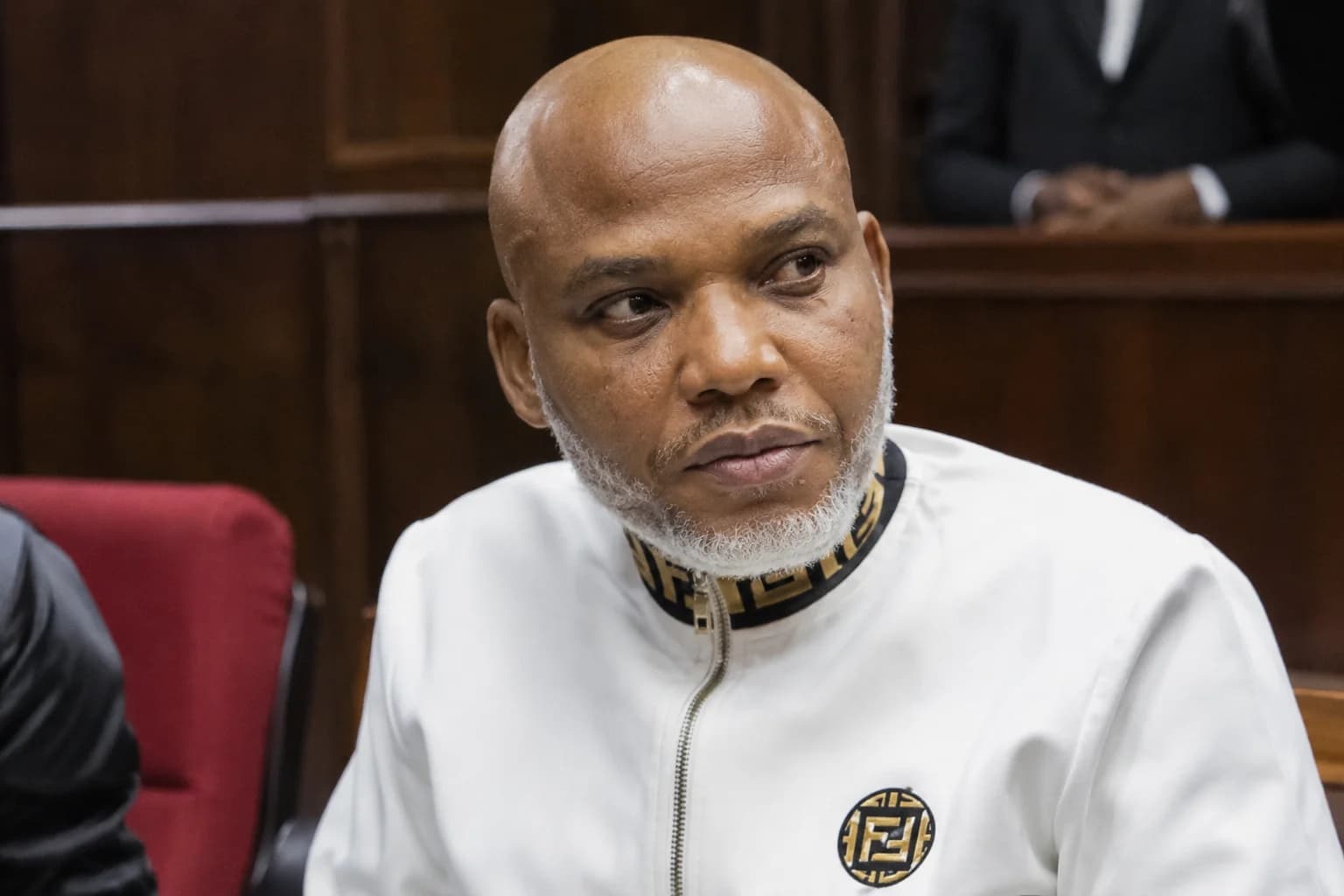
Calls for the release of Mazi Nnamdi Kanu, leader of the proscribed Indigenous People of Biafra (IPOB), are once again gaining momentum as supporters and activists raise fresh concerns about his health and treatment while serving his prison sentence.
The latest controversy centres on allegations that medical care available to Kanu has not been adequate and that medical professionals attempting to treat him have faced interference.
A statement issued on August 5, 2026, on behalf of Kanu alleged that doctors had been intimidated by the Department of State Services and that some of his health problems remain unresolved.
Those allegations have not been independently established, but they have quickly become part of the wider online campaign demanding that the government reconsider Kanu's continued imprisonment.
A New Chapter in an Old Battle
Kanu's detention has been one of Nigeria's most politically sensitive legal cases for years.
His supporters describe him as a political activist who has been punished for advocating self-determination for the South-East.
The Nigerian government, however, has prosecuted him over terrorism-related offences and has maintained that his case should be determined through the judicial process.
In November 2025, Kanu was convicted and sentenced to life imprisonment after being found guilty on terrorism charges.
That means the current calls for his release are taking place against a very different legal background from earlier campaigns, when he was still awaiting trial.
Why His Treatment Is Back in the Spotlight
The latest claims focus heavily on Kanu's health.
His representatives have alleged that he has continued to experience medical problems and that doctors have not been allowed to operate with complete independence.
One recent statement specifically referred to tinnitus and severe sleep disruption, while alleging that attempts by medical professionals to address the problem were frustrated.
These claims have generated renewed concern among supporters who argue that imprisonment should not prevent a convicted person from receiving proper medical care.
That principle is broader than Kanu's case.
A person can be imprisoned while retaining basic rights relating to humane treatment and access to healthcare.
The "Inconsistent Treatment" Argument
One of the most repeated arguments among Kanu's supporters is that Nigeria does not treat all politically controversial detainees equally.
They point to other high-profile figures who have been released, granted bail or otherwise allowed to operate outside prison and ask why Kanu's case should be treated differently.
That argument has featured prominently in online discussions for months.
In February 2026, a traditional ruler from the South-East publicly appealed to President Bola Tinubu to release Kanu, arguing that his continued detention was fuelling agitation among young people in the region.
The appeal demonstrates that calls for Kanu's release are no longer limited to his immediate supporters.
But the Government Has a Different Position
The government's position has been that Kanu's case cannot simply be compared with other activists.
President Tinubu's Special Adviser on Public Communication and Orientation, Sunday Dare, previously rejected comparisons between Kanu and Yoruba Nation activist Sunday Igboho.
Dare argued that the government views Kanu's conduct as involving insurrection and violence, while describing Igboho's activism differently.
That distinction is central to the government's argument.
Supporters see Kanu as a political prisoner.
The government sees a convicted person who was prosecuted for serious offences.
Those two narratives remain fundamentally opposed.
The Debate Is Exploding Again Online
On social media, particularly among Kanu supporters, the latest health allegations have reignited calls under the familiar Free Nnamdi Kanu banner.
Supporters are demanding that the government either release him or ensure that he receives unrestricted access to independent medical care.
Some are also questioning why medical information surrounding his condition is not being communicated more transparently.
Critics, however, have pushed back against what they consider attempts to use health concerns to undermine a criminal conviction.
They argue that Kanu's supporters should allow the legal process to run its course.
"He Has Been Punished Enough"
A major theme among supporters is that Kanu has already spent years in detention and that continued imprisonment could deepen tensions in the South-East.
They argue that releasing him under appropriate conditions could create an opportunity for dialogue and reconciliation.
Some have pointed to Kanu's previous calls for an end to the South-East's controversial sit-at-home order as evidence that his influence could potentially be used to support peace.
Kanu's position on ending sit-at-home directives has previously been reported and discussed extensively.
Others Say Release Would Undermine the Courts
Opponents of an immediate release take a fundamentally different view.
They argue that Kanu was tried and convicted by a court and that political pressure should not replace the judicial process.
For this group, the central question is not whether Kanu has supporters.
It is whether a person convicted of terrorism-related offences should be released simply because politicians, activists or community leaders demand it.
That argument has also gained support online.
The Medical Question Is Different
However, even people who support Kanu's conviction can distinguish between punishment and medical care.
A prison sentence does not mean a prisoner should be denied necessary healthcare.
This is why the latest allegations deserve scrutiny independently of the political arguments surrounding Kanu.
If his representatives are making claims about interference with doctors, the appropriate response is not simply another political argument.
The authorities should provide clear information about his medical treatment and address any credible concerns.
Nigeria's Prison System Is Already Under Scrutiny
The Kanu controversy is also taking place against broader concerns about conditions in Nigerian prisons.
A detailed report by PRNigeria on Kanu's imprisonment noted that Nigerian correctional law provides for standards covering healthcare, hygiene, food, visitation and rehabilitation, while also highlighting broader problems such as overcrowding, inadequate food and weak enforcement of inmates' rights.
That makes Kanu's case part of a much larger discussion.
The question should not only be:
What happens to Nnamdi Kanu?
It should also be:
Are Nigerian prisoners receiving the treatment guaranteed to them under the law?
Why Kanu's Case Remains So Sensitive
Kanu's influence extends far beyond the courtroom.
For many people in the South-East and among the wider pro-Biafra movement, he remains a symbol of resistance and self-determination.
For others, his rhetoric and the violence associated with the broader separatist conflict make him a dangerous political figure.
That explains why virtually every development involving him produces sharply divided reactions.
Even his imprisonment has become part of the political argument.
The South-East Factor
The continued detention of Kanu has also remained an issue in South-East politics.
Political leaders and prominent Nigerians from the region have periodically called for his release, arguing that resolving the case could contribute to reducing tension and insecurity.
In June 2026, IPOB criticised Anambra Governor Charles Soludo after Soludo opposed Peter Obi's demand for Kanu's release, illustrating how politically divisive the issue remains.
The disagreement shows that even among people from the same region, there is no unified position on how Kanu's case should be handled.
What About His Legal Options?
Kanu's supporters continue to argue that his conviction should be challenged through the legal system.
That is important because the current situation differs significantly from the period before his conviction.
He is no longer simply an awaiting-trial detainee.
He is a convicted prisoner serving a life sentence.
Any release would therefore require a legal or executive pathway consistent with Nigerian law.
Activists Want More Than a Political Statement
For activists demanding Kanu's freedom, another statement from government officials is unlikely to settle the matter.
They want concrete action.
That could mean:
Independent medical access.
Greater transparency over his health.
Review of his conviction through the courts.
Consideration of clemency or another lawful release mechanism.
Dialogue with South-East stakeholders.
Supporters argue that such steps could help reduce tension rather than deepen it.
The Government Also Has a Responsibility
The government, meanwhile, has a responsibility to explain its position clearly.
If Kanu's continued imprisonment is based on his conviction, authorities should communicate the legal basis for his detention.
If there are restrictions on his medical treatment, they should be explained.
And if his representatives' allegations are inaccurate, the government has an opportunity to provide evidence and correct the record.
Silence tends to create an information vacuum.
And in Kanu's case, that vacuum is quickly filled by social media.
X Has Become Part of the Battlefield
The latest conversation illustrates the power --- and danger --- of social media in politically sensitive cases.
Supporters can mobilise thousands of people around a claim within minutes.
Critics can respond just as quickly.
Old photographs and videos are frequently reposted as if they are current, while unverified claims can spread alongside legitimate reports.
This is particularly relevant in Kanu's case because misinformation about his detention has circulated before.
For example, fact-checkers have previously identified supposed photographs of Kanu inside prison as AI-generated.
That makes verification especially important.
What Nigerians Are Really Arguing About
Beneath the arguments over Kanu is a much bigger question about Nigeria's justice system.
Can the country simultaneously enforce national security laws while protecting the rights of politically unpopular prisoners?
Can someone be convicted of a serious offence and still have his medical and human rights protected?
Can the government maintain national security without allowing a detention to become a symbol of political persecution?
Those questions do not have to be mutually exclusive.
The Bigger Picture
Kanu's case has lasted for years and has become deeply intertwined with Nigeria's debates about federalism, self-determination, security and human rights.
His conviction did not end those debates.
If anything, it has moved them into a new phase.
The focus is now shifting from the question of whether he should stand trial to whether he should remain imprisoned and under what conditions.
That is why the latest health allegations matter.
The Bottom Line
Fresh calls for Mazi Nnamdi Kanu's release are gaining momentum as activists and his representatives raise concerns about his medical treatment and conditions in custody.
A statement dated August 5 alleged that DSS officials interfered with doctors treating Kanu and that health problems, including tinnitus, remain inadequately addressed. Those claims remain allegations and require independent verification.
Kanu is currently serving a life sentence following his 2025 conviction on terrorism charges, making his legal situation fundamentally different from earlier campaigns for his release.
Online, supporters argue that his continued detention is unjust and point to what they describe as inconsistent treatment of other political figures.
Critics insist that his conviction must be respected and that political campaigns should not override the courts.
But there is one issue that should transcend the politics:
Whatever a person's political beliefs or criminal conviction, allegations about inadequate medical treatment in custody deserve a clear, transparent response.
And until the government, Kanu's legal team and independent medical professionals provide Nigerians with a fuller picture, the debate over his treatment --- and his future -- is unlikely to disappear.
Tags
PUBLISHER NOTE
About Talk Ya True
Talk Ya True publishes independent reporting and analysis with clear attribution, source transparency and corrections when needed.
Related Articles

Business
Petrol Hits ₦1,500 in Parts of Nigeria as Global Oil Surge Deepens Fuel Crisis
Nigeria
37 Suspected Illegal Miners Die in NSCDC Custody as Tinubu Orders Independent Probe
Business
Nigeria’s Inflation Falls to 15.39% as Food Price Pressure Eases

Business
Nigeria’s Oil Output Hits 1.68m Barrels Per Day as OPEC Compliance Continues
Stay Informed
Get the latest stories from Nigeria.
Free news updates. Unsubscribe anytime.
By subscribing, you agree to receive free news updates from Talk Ya True. You can unsubscribe at any time.