Business
Naira Holds Firm as Brent Oil Climbs Above $94 Amid Middle East Tensions
The Nigerian naira is showing signs of relative stability, trading around ₦1,345 to the dollar on the official market as Brent crude rises above $94 a barrel. Higher oil prices could provide support for Nigeria’s foreign-exchange position, although global supply risks and the wider cost-of-living crisis remain major concerns.
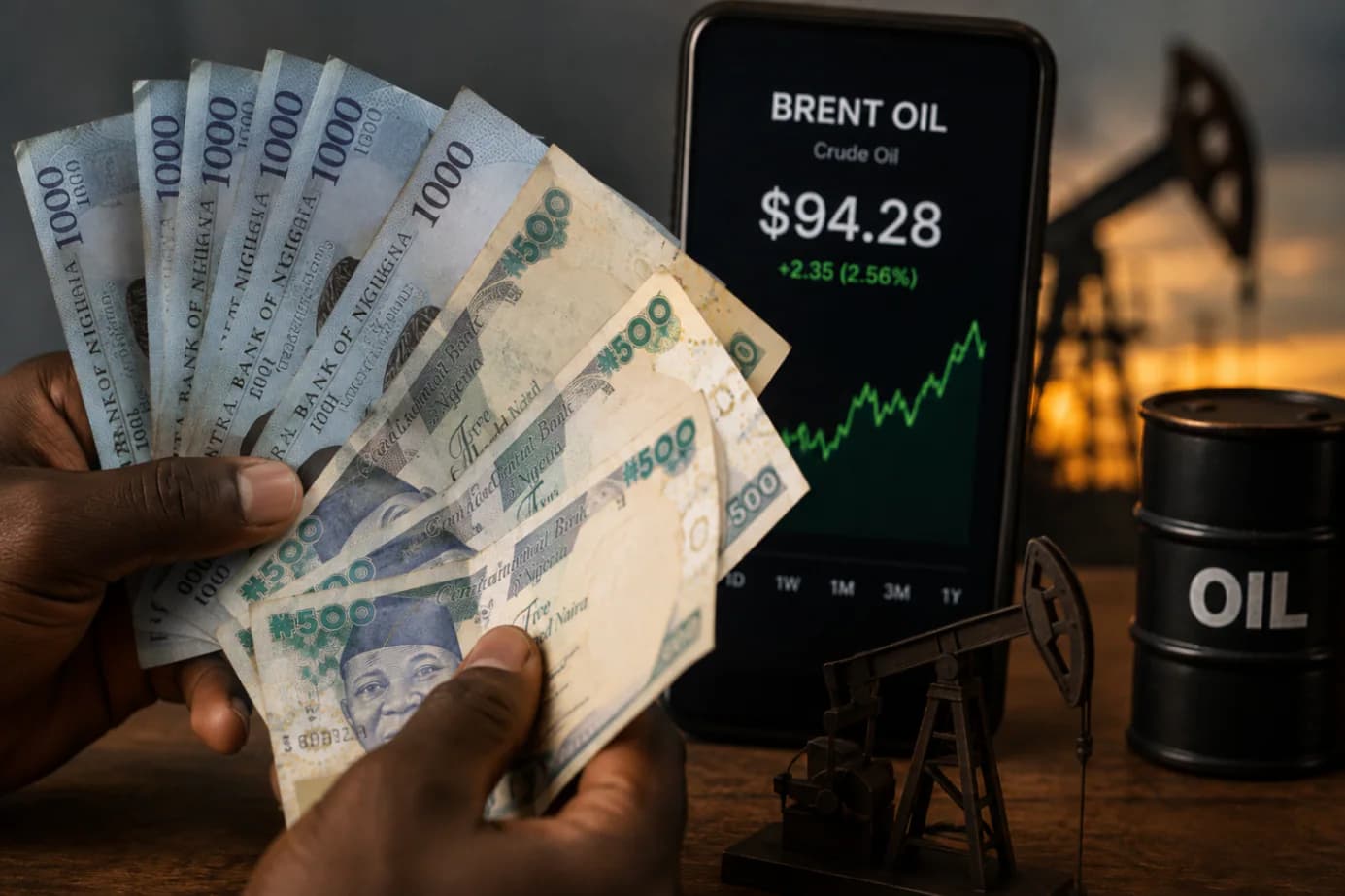
The Nigerian naira is holding relatively firm against the US dollar as international oil prices climb sharply, giving Africa's largest oil producer another potential boost from the global energy market.
The naira was quoted at around ₦1,345 to the dollar on the official market on Thursday, compared with approximately ₦1,358 a week earlier, according to Reuters. Street-market trading was reported at around ₦1,410 to the dollar.
At the same time, Brent crude rose above $94 a barrel, reaching its highest level in more than three weeks as concerns over Middle East supply disruptions continued to push prices higher.
The combination of a relatively stable naira and stronger oil prices is attracting attention because crude exports remain a crucial source of Nigeria's foreign-exchange earnings.
Naira Gains Ground
According to Reuters, the naira was trading at ₦1,345 per dollar on Thursday, compared with ₦1,358 a week earlier.
Traders cited continued inflows from offshore investors as one factor supporting the currency.
One trader told Reuters that the naira could remain within a relatively narrow range in the coming week, reflecting what the trader described as good flows into the market.
The development represents a notable contrast with the severe currency instability Nigeria experienced following the foreign-exchange reforms introduced after President Bola Ahmed Tinubu took office.
However, the difference between the official and street rates remains significant.
While the official rate was around ₦1,345, Reuters reported street trading around ₦1,410 per dollar, showing that pressure has not completely disappeared from the wider foreign-exchange market.
Oil Moves Above $94
The other major development is happening in the international oil market.
Brent crude rose by more than 2% on Thursday, reaching approximately $93.81 per barrel in Reuters trading data, while other market data placed Brent above $94.
The increase marked the fifth consecutive session of gains and pushed the benchmark to its highest level since July 24.
The immediate driver is geopolitical uncertainty surrounding the conflict involving Iran, the United States and Israel, with concerns about the security of energy supplies and shipping routes in the Middle East.
The Strait of Hormuz is particularly important because a significant share of global oil consumption has historically passed through the waterway.
Although the strait has reportedly remained open, shipping activity has fallen substantially compared with normal levels, adding a risk premium to crude prices.
Why Higher Oil Prices Matter to Nigeria
Nigeria is heavily dependent on crude oil for foreign-exchange earnings and government revenue.
When international oil prices rise, Nigerian oil exporters can potentially generate more dollar revenue from each barrel sold.
That can provide additional foreign currency to the economy and potentially support the naira if production and export volumes remain strong.
The relationship is not automatic, however.
Higher global oil prices do not necessarily translate into an immediate improvement in household finances or cheaper goods.
Nigeria must also maintain sufficient oil production, manage its fiscal position and ensure that increased oil revenue reaches government finances and the broader economy.
Naira Stability Comes After Difficult Reforms
The latest currency movement comes after several years of major changes to Nigeria's economic policy.
The Tinubu administration removed the petrol subsidy and significantly changed the country's foreign-exchange system.
Finance Minister Taiwo Oyedele said this week that the reforms helped Nigeria avoid what he described as a potential economic collapse, while improving public finances, foreign reserves and investor confidence.
However, those same reforms caused substantial short-term pain for households.
The naira's devaluation increased the local cost of imported goods, while the removal of fuel subsidies pushed up transportation and living costs.
Reuters reported that although investors and international lenders have generally welcomed the reforms, ordinary Nigerians have continued to experience significant cost-of-living pressures.
The Good News — and the Catch
The combination of stronger oil prices and a firmer naira could be positive for Nigeria's economy if it lasts.
Higher oil revenues could improve the country's foreign-exchange liquidity and strengthen government finances.
A more stable naira could also provide businesses with greater certainty when planning imports and other dollar-linked transactions.
But there is an important catch.
Nigeria's economy does not benefit from higher oil prices in isolation.
Production levels, oil theft, pipeline disruptions, investment and government spending all influence how much of the benefit actually reaches the country.
Nigeria also remains vulnerable to a sudden fall in oil prices if geopolitical tensions ease and global supply increases.
Middle East Conflict Creates Opportunity and Risk
The current oil rally is being driven partly by a crisis outside Nigeria.
That creates an unusual situation for the country.
On one hand, higher oil prices could improve Nigeria's earnings.
On the other hand, prolonged geopolitical tensions can increase the cost of imported energy products and other commodities, potentially putting additional pressure on inflation and households.
The Reuters global market report noted that higher oil prices are already contributing to concerns about inflation in international markets.
For Nigeria, the ultimate effect will therefore depend on whether the additional oil revenue outweighs the inflationary consequences of a more expensive global energy market.
What Nigerians Should Watch
There are several indicators worth watching over the coming weeks:
The naira: Whether the official exchange rate can remain around current levels.
Oil prices: Whether Brent remains above $90 or retreats if Middle East tensions ease.
Nigeria's oil production: Higher prices are only useful if Nigeria can maintain or increase production.
Foreign reserves: Rising reserves would provide another important signal of improved external liquidity.
Fuel prices: Changes in international crude prices can eventually influence Nigeria's domestic petroleum market.
Inflation: Any benefit from a stronger naira could be offset if energy and imported commodity prices continue rising.
What People Are Saying Online
The latest market movement has generated plenty of discussion among Nigerians online.
Some users are celebrating the naira's improvement against the dollar and arguing that the country's economic reforms are beginning to produce results.
Others remain sceptical, pointing out that the exchange rate alone does not determine whether ordinary Nigerians are better off.
A recurring argument is that a naira trading around ₦1,345 means little to households if food, rent, transport and other essential expenses remain high.
Others are watching the oil market more closely, arguing that Nigeria should take advantage of higher crude prices to strengthen its reserves, improve production and reduce its vulnerability to future oil-price shocks.
That debate reflects the larger question surrounding Nigeria's economic reforms: are improvements in macroeconomic indicators beginning to translate into better living conditions for ordinary Nigerians?
The answer remains contested.
What Happens Next?
For now, the naira is showing relative stability while oil prices are moving in Nigeria's favour.
But both developments remain vulnerable to external and domestic factors.
The naira's recent performance will depend partly on continued dollar inflows and liquidity in Nigeria's foreign-exchange market.
Oil prices, meanwhile, will remain highly sensitive to developments in the Middle East and the possibility of disruptions to global energy supplies.
For Nigeria, the ideal scenario would be to combine higher oil revenues, stronger production, stable foreign reserves and a more predictable exchange rate.
Whether those gains can be sustained — and whether they eventually translate into cheaper living costs and stronger household purchasing power — will be the bigger test.
For now, the latest numbers provide some positive news for Nigeria's economy, but they are not yet enough to declare victory over the country's broader economic challenges.
What People Are Saying
The online conversation is largely divided between optimism and caution.
Optimists are pointing to the naira's move toward ₦1,345/$ and stronger crude prices as evidence that Nigeria's external position may be improving.
Critics argue that exchange-rate gains mean little if Nigerians continue to face high food, housing and transportation costs.
Others are asking whether Nigeria can use the current oil-price environment to build stronger reserves and invest in production rather than becoming dependent on another temporary oil boom.
The most important point is that a stronger naira and higher oil prices are positive indicators, but neither automatically means that household living standards have improved.
Sources
Reuters — Africa FX: Latest naira exchange-rate data and trader commentary.
Reuters — Oil markets: Brent crude's rise above $93 and Middle East supply concerns.
Reuters — Global markets: Brent above $94 and the wider inflation implications of higher oil prices.
Reuters — Nigeria's economic reforms: Finance Minister Taiwo Oyedele's assessment of the Tinubu administration's reforms.
U.S. Energy Information Administration: Outlook for Brent crude prices and global oil supply risks.
Tags
PUBLISHER NOTE
About Talk Ya True
Talk Ya True publishes independent reporting and analysis with clear attribution, source transparency and corrections when needed.
Related Articles

Nigeria
24 Bandits Killed as Security Forces Foil Mass Kidnap Attempt in Katsina

Nigeria
Security Agents Block Military Veterans From Protesting Pension Delays in Abuja

Nigeria
Yari Donates 43 Cows, 356 Bags of Rice and ₦12.5m to Zamfara Zawiyyah for Maulud

Business
Nigeria’s Internet Subscriptions Hit 157.4 Million as Broadband Penetration Reaches 56.1%
Stay Informed
Get the latest stories from Nigeria.
Free news updates. Unsubscribe anytime.
By subscribing, you agree to receive free news updates from Talk Ya True. You can unsubscribe at any time.