Nigeria
VIDEO SHOWS REMAINS BEING MOVED FOR MASS BURIAL AT BENUE TEACHING HOSPITAL, RAISING QUESTIONS OVER UNCLAIMED BODIES
A video circulating on X has sparked questions after what appears to show hospital workers moving human remains onto a truck for a mass burial in Benue State. The post identifies the location as Benue State University Teaching Hospital (BSUTH), Makurdi, and describes the remains as unclaimed. However, the circumstances surrounding the bodies, including how they came to be classified as unclaimed and the identity of the people shown in the footage, have not been independently confirmed. The development has renewed questions about how Nigerian hospitals handle unidentified and unclaimed remains.
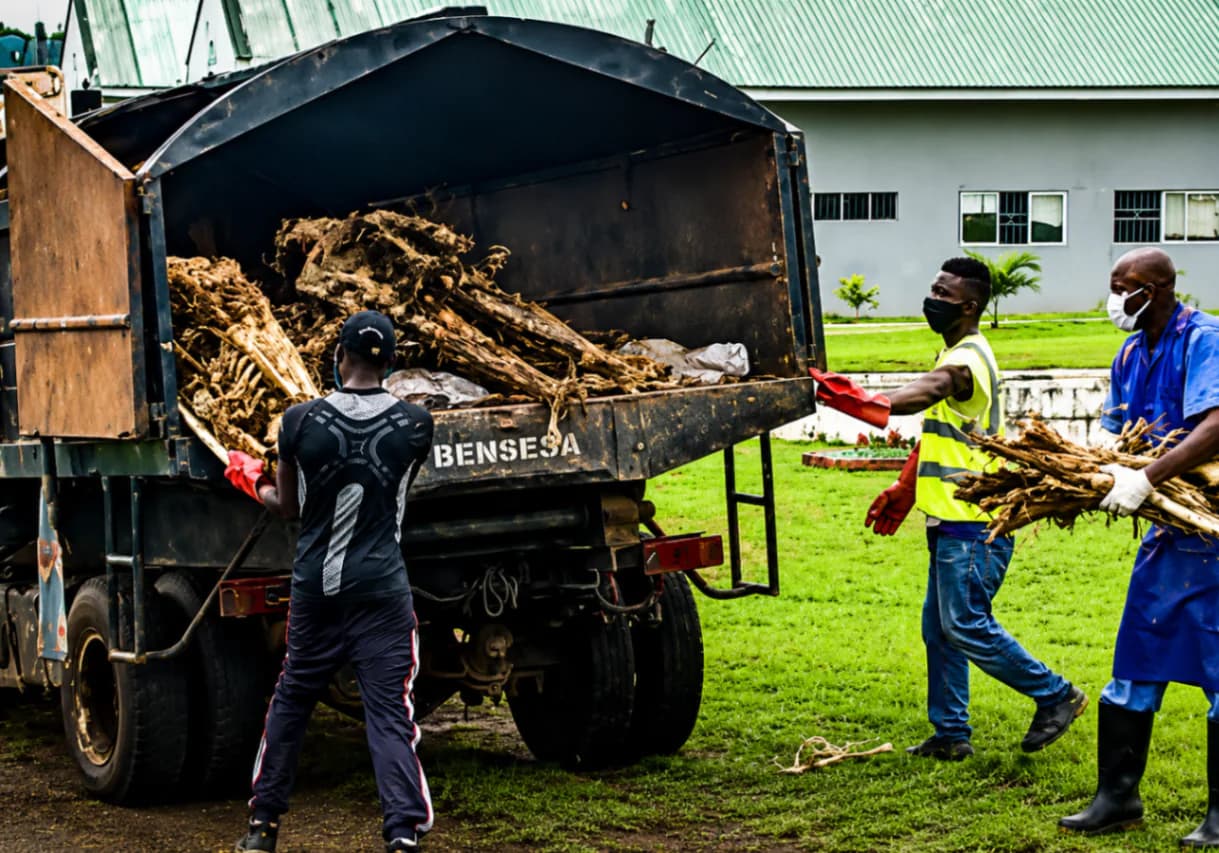
A video circulating on social media has triggered an uncomfortable conversation about what happens to human remains that remain unidentified or unclaimed in Nigerian hospitals.
The footage, shared on X by user HAYZEDProS, appears to show workers moving several human remains onto a truck.
The post identifies the location as Benue State University Teaching Hospital (BSUTH) in Makurdi and describes the remains as unclaimed bodies being taken for mass burial.
The footage has prompted questions about how the bodies came to be classified as unclaimed and what happens when no relative comes forward to identify or claim a deceased person.
The questions are particularly sensitive because behind every unidentified or unclaimed body is potentially a person who once had a family, friends and a community.
WHAT THE X POST SAYS
The X user who shared the video questioned how the bodies became "unclaimed."
The post raised two possible explanations.
One possibility suggested was that some of the bodies could have been people who died on the road and whose relatives could not locate them.
Another possibility was that relatives may have brought deceased family members to a mortuary and later abandoned the bodies.
The post did not establish either explanation as fact.
Instead, the questions reflect the uncertainty surrounding the circumstances of the remains shown in the video.
That distinction is important.
A body being classified as unclaimed does not automatically tell the public how the person died, whether the person was identified, or why no family member ultimately took responsibility for the burial.
WHAT WE CAN VERIFY
The video is circulating on X and the post identifies the location as BSUTH in Makurdi.
However, I have not found an official statement from BSUTH confirming the specific video, the number of remains involved or the circumstances surrounding their planned disposal.
BSUTH's official website confirms that the hospital operates an Accident and Emergency department and other major clinical services in Makurdi.
The lack of an official statement means the details shown in the social-media post should be treated carefully until the hospital or another competent authority provides confirmation.
A RELATED BENUE CASE
There is, however, documented evidence that the issue of unclaimed remains has recently arisen in Benue.
In June 2026, the Federal Medical Centre (FMC), Makurdi, issued a public notice concerning plans for the mass burial of unclaimed corpses in its mortuary.
The notice called on families of missing persons to visit the mortuary to identify and claim bodies before a stated deadline, after which remaining unclaimed bodies would be buried according to established procedures.
That case involved FMC Makurdi, not BSUTH.
The distinction matters because it would be misleading to use the FMC notice as proof of what is happening at BSUTH.
However, it does demonstrate that the issue of unidentified and unclaimed remains is a real administrative challenge faced by medical facilities in the state.
WHAT DOES "UNCLAIMED" MEAN?
The term can cover different circumstances.
Some deceased people may have no immediately identifiable relatives.
Others may be identified but remain unclaimed for an extended period.
Some bodies may be brought into hospitals or mortuaries after accidents or other incidents without relatives being immediately available.
In other cases, families may be unable or unwilling to take responsibility for burial.
A Nigerian Medical Journal study examining abandoned and unidentified bodies at a tertiary health institution found that both identified-but-abandoned and unidentified/unclaimed remains can occur.
The study found that some bodies were brought to the morgue by relatives, while others were brought by hospital staff or security agencies.
That research is important because it demonstrates that "unclaimed" does not necessarily mean "unknown."
A person can be identified and still remain unclaimed.
WHY WOULD A BODY REMAIN UNCLAIMED?
There is no single answer.
In some cases, the person may have been travelling without identification.
In other cases, relatives may not immediately know where the person was taken after an accident.
A person who dies far from home may also be difficult for relatives to trace.
There can also be financial and social reasons why families fail to claim or bury remains.
These possibilities should not be assumed to apply to the people shown in the video.
They simply demonstrate why the circumstances surrounding each unclaimed body need to be established individually.
THE QUESTIONS RAISED BY THE VIDEO
The footage naturally raises several questions.
Who are the people shown in the video?
How long have the remains been in the mortuary?
Were they identified?
Were attempts made to locate relatives?
Were some of them victims of road crashes or other accidents?
Were police or other authorities involved in identifying them?
How long must a hospital keep an unclaimed body before burial?
Who authorised the burial?
Where are the remains being taken?
And most importantly, were the appropriate procedures followed?
Those questions deserve answers from the relevant authorities.
WHY MASS BURIALS ARE SOMETIMES NECESSARY
Mortuaries are not designed to store human remains indefinitely.
When bodies remain in storage for prolonged periods, hospitals face practical, health and capacity challenges.
Cold-room capacity is limited.
Storage costs money.
Mortuary staff must maintain facilities.
Newly deceased patients and accident victims also need space.
This means hospitals sometimes have to deal with long-term unclaimed remains.
The responsible approach is to ensure that reasonable efforts are made to identify the deceased and locate relatives before burial.
The June FMC Makurdi notice illustrates this kind of approach, with the facility publicly calling on families of missing persons to come forward before the planned burial.
THE HUMAN SIDE OF UNCLAIMED REMAINS
The phrase "unclaimed body" can sound clinical.
But every body represents a human life.
Someone had a name.
Someone may have been someone's parent.
Someone's child.
Someone's sibling.
Someone's friend.
Someone may have been expected home.
That is why the handling of unidentified and unclaimed remains requires dignity.
Even when no relative can be found, the deceased person deserves respectful treatment.
THE ROLE OF HOSPITALS
Hospitals and mortuaries have an important responsibility when dealing with unidentified or unclaimed remains.
They need accurate records.
They need identification procedures.
They need to work with police and other relevant agencies when necessary.
They need to document when and where a body was received.
They need to make reasonable efforts to identify the deceased.
And when burial eventually becomes necessary, it should be carried out according to applicable procedures.
These measures are important not only for the deceased but also for families who may eventually discover that a missing relative had been taken to a mortuary.
THE ROLE OF POLICE AND OTHER AGENCIES
Hospitals cannot always identify an unknown body by themselves.
Police, road safety officials and other agencies may become involved when bodies are recovered from accident scenes or other locations.
A Nigerian Medical Journal study found that security or uniformed agencies were among those who deposited bodies in the morgue examined by researchers.
This makes cooperation between hospitals and security agencies particularly important.
If someone dies without identification, information needs to move between agencies so that relatives have the best possible chance of locating their loved one.
WHY THE VIDEO HAS GENERATED AN EMOTIONAL REACTION
The sight of human remains being moved onto a truck is naturally disturbing.
For many people watching the footage, the immediate reaction is to wonder how the situation could have reached that point.
The X post itself captures that uncertainty.
The user is essentially asking:
Where did these people come from?
Who were they?
Did someone search for them?
Did their families know they were dead?
Could somebody still be looking for them?
Those are difficult questions.
But they are also important ones.
TALK YA TRUE ANALYSIS
The most important thing about this story is not the shock value of the video.
It is the unanswered question of identity.
Nigeria has thousands of people reported missing every year, while hospitals, police facilities and mortuaries sometimes deal with unidentified remains.
When those two realities exist at the same time, identification becomes more than an administrative exercise.
It becomes a matter of giving families closure.
Imagine a family searching for a missing relative for months or years while that person has already died and their remains are sitting somewhere in a hospital mortuary.
Without proper identification systems, that family may never know what happened.
That is why Nigeria needs stronger systems for recording unidentified remains.
Photographs, fingerprints, dental records, DNA where appropriate, police databases and coordinated missing-person reporting could all help.
The objective should be simple:
Before an unidentified person is buried, authorities should make every reasonable effort to determine who that person was.
And when burial eventually becomes unavoidable, the process should preserve enough information to allow future identification if new evidence emerges.
WHAT WE SHOULD NOT DO
The video should not become an excuse for spreading unverified claims.
There is currently no evidence establishing that the bodies were deliberately abandoned by families.
There is also no evidence from the material available to us establishing that the bodies were victims of road accidents.
And there is no verified evidence showing that the hospital acted improperly.
Those possibilities can be investigated.
They should not be presented as facts.
The right response to disturbing footage is to ask questions and seek answers.
Not to manufacture them.
WHAT AUTHORITIES SHOULD CLARIFY
BSUTH should ideally clarify whether the video was recorded at its facility.
If confirmed, the hospital should explain:
How many remains were involved?
How long had they been in the mortuary?
How many had been identified?
How many were genuinely unidentified?
What efforts were made to locate relatives?
Who authorised the mass burial?
Was the burial conducted according to applicable procedures?
Where were the remains taken?
Providing those answers would help prevent speculation and reassure the public that the deceased were treated with dignity.
FINAL WORD
A video showing what appears to be human remains being moved for mass burial has raised difficult questions in Benue State.
The X post identifies the location as Benue State University Teaching Hospital in Makurdi and describes the remains as unclaimed.
However, the specific circumstances surrounding the video have not yet been independently confirmed by BSUTH.
A separate and documented case at Federal Medical Centre, Makurdi, shows that mass burial of unclaimed remains is a real issue in the state, with the hospital publicly asking families of missing persons to come forward before a planned burial in June 2026.
The current video therefore deserves investigation, not speculation.
Every unclaimed body represents a person whose story may be unknown.
The responsibility of authorities is to make every reasonable effort to discover that story before the final burial.
Because somewhere, there may be a family still asking the most painful question of all:
"Where is our loved one?"
KEY FACTS
Incident: Video showing human remains being moved onto a truck
Location claimed by X post: Benue State University Teaching Hospital, Makurdi, Benue State
Source: X post by HAYZEDProS
Claim: The remains were being moved for mass burial as unclaimed bodies
Official BSUTH confirmation: Not located at the time of writing
Number of remains: Not independently confirmed
Identity of the deceased: Not confirmed
Cause of death: Not confirmed
Reason the remains were classified as unclaimed: Not confirmed
Related Benue development: FMC Makurdi announced a planned mass burial of unclaimed corpses in June 2026
Important clarification: The FMC Makurdi case is separate from the BSUTH video and should not be presented as confirmation of the video's circumstances
Status: Developing
SOURCES
X post by HAYZEDProS: Claim concerning unclaimed remains at Benue State University Teaching Hospital.
Benue Today: Report on FMC Makurdi's June 2026 notice concerning planned mass burial of unclaimed corpses.
Nigerian Medical Journal: Study documenting identified-but-abandoned and unidentified/unclaimed bodies in a Nigerian tertiary health institution.
Benue State University Teaching Hospital official website: Hospital information and departments.
Tags
PUBLISHER NOTE
About Talk Ya True
Talk Ya True publishes independent reporting and analysis with clear attribution, source transparency and corrections when needed.
Related Articles
Politics
DSS Seeks to Pause Sowore Trial Until After 2027 Election as Activist Demands Case Withdrawal
Nigeria
Comedian Aiza Nwosu Shot Dead in Awka as Police Launch Manhunt for Attackers
Nigeria
Umahi Orders Arrest of Hartland MD Over Alleged Failure to Complete ₦14bn Benin-Onitsha Road Section
Nigeria
Ogun Forest Meth Lab: How NDLEA Uncovered a ₦480bn Alleged Drug Operation — and What Happens Next
Stay Informed
Get the latest stories from Nigeria.
Free news updates. Unsubscribe anytime.
By subscribing, you agree to receive free news updates from Talk Ya True. You can unsubscribe at any time.